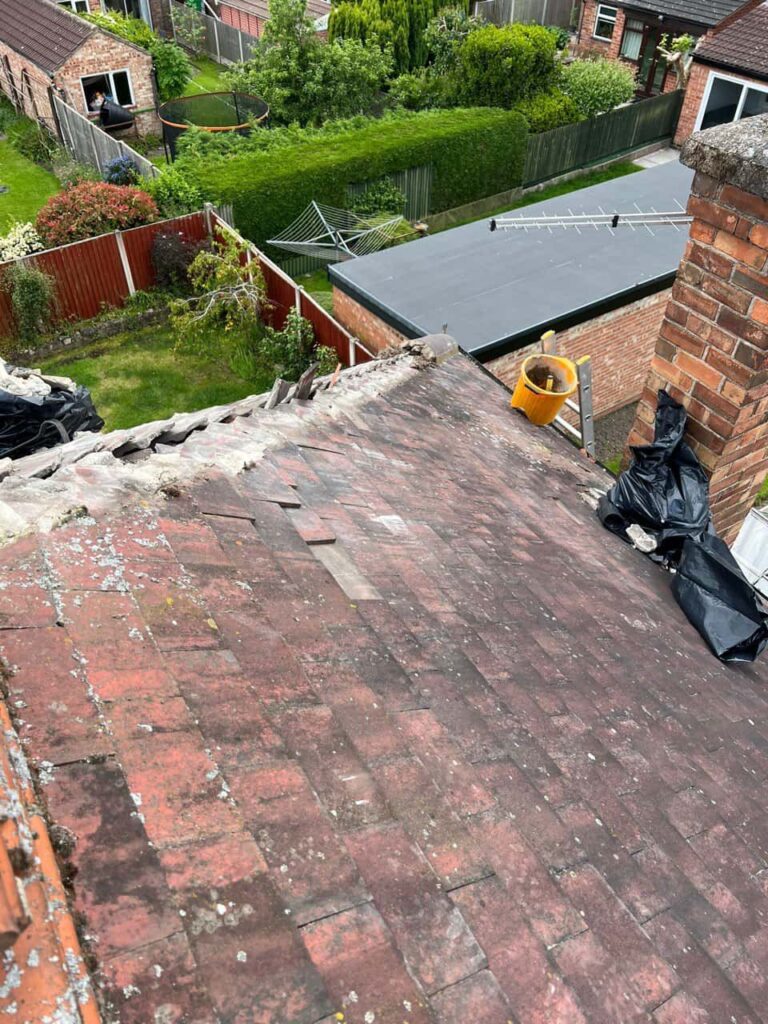
A roof leak that returns after appearing to have been resolved can be particularly frustrating. You may notice a damp patch after heavy rain, arrange for the obvious problem to be addressed and assume the roof is watertight again, only for the same signs to reappear weeks or months later.
Recurring leaks should not simply be treated as the same minor problem happening again. They can indicate that the original source of water ingress was not fully identified, that more than one defect exists, or that deterioration elsewhere on the roof is allowing water to find another route inside.
For homeowners in West Bridgford, Nottingham, the sensible next step is a thorough assessment of the affected area and the wider roof. At West Bridgford Roofing Repairs, identifying why a leak keeps returning is an important part of providing an appropriate and lasting roof repair.
Why Can a Roof Leak Return After a Repair?
There are several possible reasons.
The previous repair itself may not necessarily be the problem. Water can travel beneath roof coverings and along structural elements before becoming visible indoors, meaning the original leak may have been incorrectly traced.
Alternatively, several defects may have existed at the same time, with only the most obvious one receiving attention.
Possible explanations for a recurring leak include:
- The original source was not correctly identified
- More than one entry point is present
- Surrounding roofing materials have deteriorated
- Flashing or roof junctions require attention
- Another tile or slate has become damaged or displaced
- An older repair has deteriorated
- The problem extends beyond the previously repaired section
- Water is travelling before appearing internally
Understanding which of these applies is far more useful than repeatedly treating the visible damp patch.
The Damp Patch May Not Be Directly Below the Leak
One of the biggest challenges with roof leak repairs is locating the actual entry point.
Water does not necessarily travel straight down.
Once it passes through the external roof covering, it can move along underlay, timbers and other components before reaching a point where it drips into the property.
This means a stain on the bedroom ceiling, for example, does not automatically indicate that the defect is immediately above that location.
The internal evidence provides a useful starting point, but the external roof still needs to be investigated carefully.
Start by Looking at When the Leak Happens
The conditions under which a leak appears can provide valuable clues.
Try to notice whether water ingress occurs:
- During every period of rainfall
- Only after prolonged rain
- During particularly heavy downpours
- When rain is accompanied by strong winds
- Immediately after rainfall begins
- Several hours after wet weather
- Only occasionally
A leak that occurs during wind-driven rain may involve a different vulnerable area from one that appears consistently during prolonged rainfall.
Providing this information during a professional inspection can help narrow down the investigation.
Check Whether the Leak Is Returning in Exactly the Same Place
The location of internal dampness is also useful.
If staining repeatedly appears in precisely the same area, there may be an unresolved defect allowing water to follow a familiar route.
If new damp patches are developing elsewhere, the situation could be broader.
Several areas of water ingress may indicate multiple individual defects or more widespread deterioration across the roof.
This distinction can influence whether another targeted repair is appropriate or whether a larger section requires attention.
Damaged Roof Coverings Need Careful Inspection
Tiles and other roof coverings form the main barrier against rainfall.
A cracked, broken, displaced or missing unit can create an obvious vulnerability. However, replacing one visibly damaged tile does not always mean the complete problem has been resolved.
Nearby roof coverings should also be checked.
If several components have deteriorated or become insecure, focusing exclusively on the most obvious defect can leave other weaknesses untouched.
Professional inspection considers the condition of the surrounding area rather than treating each visible defect in isolation.
Flashing Can Be Responsible for Persistent Leaks
Flashing protects vulnerable roof junctions and transitions.
Where it becomes loose, damaged or deteriorated, relatively small openings can allow rainwater to penetrate.
These problems can be particularly difficult to diagnose because water may enter at the flashing before travelling to another location inside the roof.
Where a recurring leak appears close to a chimney, wall or another roof junction, the associated flashing should form part of the investigation.
Roof Junctions Can Hide Difficult-to-See Defects
Areas where roof sections and different building elements meet require careful detailing.
Water naturally travels across these areas during rainfall, so relatively small weaknesses can create recurring problems.
A roof may look generally sound from a distance while containing deterioration within a junction that is difficult to identify without closer inspection.
This is one reason recurring leaks deserve professional investigation rather than repeated guesswork.
Previous Repairs Should Be Assessed, Not Automatically Blamed
If a roof starts leaking again after previous work, it is easy to assume that the repair has failed.
Sometimes it has, but this should not be assumed.
The repaired section may remain sound while another nearby component has deteriorated. Alternatively, movement elsewhere may have created a new route for water.
A proper assessment should therefore examine both the previous repair and the surrounding roof.
The objective is to understand the current source of water ingress rather than simply repeat the earlier work.
Why Adding Another Temporary Patch May Not Help
Repeatedly applying repair materials to areas that appear suspicious can make diagnosis more difficult.
If the actual source has not been identified, another patch may leave the underlying problem unchanged.
The leak then returns, sometimes in exactly the same place.
Effective roof repair should follow a clear process:
- Establish where internal moisture is appearing.
- Consider when and under what conditions it occurs.
- Inspect the relevant external roof areas.
- Examine surrounding roof coverings and details.
- Assess previous repairs.
- Identify the most likely route of water ingress.
- Carry out work appropriate to the actual defect.
This investigative approach is considerably more useful than repeatedly treating different areas without confirming the cause.
Could the Problem Be Larger Than One Leak?
Sometimes recurring water ingress is the first indication that a roof is experiencing broader deterioration.
If the roof is also showing multiple defects, the issue may no longer be confined to one isolated area.
Signs worth considering include:
- Several previous repairs
- Multiple damaged roof coverings
- Leaks appearing in different locations
- Widespread visible deterioration
- Recurring defects around several roof details
- Increasingly frequent maintenance requirements
These symptoms do not automatically mean a new roof is necessary, but they do justify assessing the roof as a complete system.
When Is Another Roof Repair Appropriate?
A further repair can still be the correct approach when the underlying roof remains generally serviceable.
For example, professional inspection may identify a specific unresolved defect or a new localised problem that can be addressed without disturbing sound sections.
Targeted repair is particularly appropriate when:
- The source can be confidently identified
- Deterioration is confined to a limited area
- Surrounding roofing materials remain sound
- Previous repairs are otherwise performing correctly
- There is no evidence of widespread failure
The key difference is that the next repair should be based on diagnosis rather than assumption.
When Should a New Roof Be Considered?
A recurring leak does not automatically mean the complete roof needs replacing.
However, replacement can become worth considering when leaks form part of much broader deterioration.
If problems continually develop across different areas, roofing materials are becoming increasingly unreliable and repairs are required repeatedly, treating one defect at a time may no longer address the overall condition.
Professional assessment can determine whether the roof remains a sensible candidate for repair or whether more comprehensive renewal would provide the appropriate solution.
Do Not Ignore a Leak Because It Stops When the Rain Stops
An intermittent leak can be easy to postpone.
Once the weather improves and the visible dripping disappears, the problem can feel less urgent.
However, the route that allowed water into the roof has not necessarily disappeared.
The next suitable period of rainfall may allow water to enter again.
Recurring moisture can also affect materials beyond the original entry point, potentially increasing the area that eventually requires attention.
Having the source investigated while the evidence is relatively localised can help prevent unnecessary deterioration.
Internal Signs Can Help With Diagnosis
Where safely accessible, evidence inside the roof space can sometimes help identify the path water has taken.
A professional assessment may consider signs such as:
- Water staining
- Damp areas
- Moisture around particular junctions
- Marks on accessible structural components
- Evidence of repeated water movement
These observations can then be compared with the external roof layout.
Neither internal nor external evidence should necessarily be considered alone. Combining the two can provide a much clearer understanding of the problem.
Why Professional Diagnosis Matters
Recurring roof leaks demonstrate why professional roofing work involves more than simply replacing the first damaged component that can be seen.
A thorough assessment considers the relationship between:
The Internal Signs
Where is moisture becoming visible?
Weather Conditions
When does the leak occur?
Roof Coverings
Are there damaged, displaced or deteriorating areas?
Flashing and Junctions
Are vulnerable details allowing water through?
Previous Repairs
Are they sound, or is deterioration occurring nearby?
The Wider Roof Condition
Is the leak isolated, or does it form part of more extensive deterioration?
This complete picture makes it possible to recommend work based on what the roof actually requires.
Early Investigation Can Preserve More Repair Options
Where a leak is caused by a small localised defect, dealing with it promptly can help keep the repair focused.
Allowing water ingress to continue can expose surrounding materials to repeated moisture and potentially increase the affected area.
Early investigation is therefore not about assuming that substantial roofing work will be required.
Quite the opposite: identifying a problem while it remains localised can sometimes make a targeted repair more achievable.
Roof Leak Repairs in West Bridgford, Nottingham
At West Bridgford Roofing Repairs, we provide professional roofing services throughout West Bridgford, Nottingham, including roof leak repairs, general roof repairs and new roofs.
When a leak keeps returning, our focus is on establishing why. That means considering the internal evidence, inspecting the relevant external roof areas and assessing whether the problem is confined to one defect or connected with wider deterioration.
Where a targeted repair remains appropriate, sound areas of the roof do not need unnecessary attention. Where the roof is experiencing more extensive problems, a broader roofing solution can be considered based on its actual condition.
Conclusion
If your roof leak keeps coming back, the next step should be to investigate the cause rather than simply repeat the same surface repair.
Recurring water ingress can happen because the original source was difficult to locate, several defects exist, surrounding materials have deteriorated or water is travelling from an unexpected point before becoming visible indoors.
A professional assessment can establish whether the problem is still suitable for a targeted roof repair or whether repeated leaks are indicating wider deterioration that requires more comprehensive attention.
If you are experiencing a recurring roof leak at your property in West Bridgford, Nottingham, contact West Bridgford Roofing Repairs. We can assess the affected area, investigate the likely source of water ingress and recommend an appropriate roofing solution based on what your roof genuinely needs.
Call us on: 0115 647 1193
Click here to find out more about West Bridgford Roofing Repairs
Click here to complete our contact form and see how we can help with your roofing needs.